


The global startup scene has grown far beyond mobile applications and software platform innovation that were popular in the recent past. Today, a new type of innovation-driven company is attracting the attention of investors and governments around the world. This type of company is known as a deep tech startup.
Deep tech startups are not just building digital applications or software solutions. Instead, they are building innovative solutions based on advanced scientific research and engineering.
From artificial intelligence and biotech to quantum computing and space tech, the list of innovative solutions being developed by these startups is long. This is because of the potential these startups have to solve complex global challenges and provide long-term technological advantages. Therefore, investors are now looking to support these startups because of the potential they have to innovate.
This article will explain what a deep tech startup is and the reasons why investors are now looking to support these startups.
What Is a Deep Tech Startup?
Deep tech startups refer to startups that build solutions based on scientific or engineering innovation. These startups originate from research laboratories or universities.
Unlike the majority of startups that build digital applications or software solutions, deep tech startups build solutions based on scientific discoveries.
Also Read: What Is a Smart Ring and How Does It Work?
Key Characteristics of Deep Tech Startups
Strong Scientific Foundation
Deep tech startups originate from academic research, experiments, or scientific discoveries developed over several years.
High Technical Complexity
The technologies employed by deep tech companies often require specialized knowledge in physics, biology, chemistry, or computer science.
Longer Development Cycles
Unlike software startups, which can launch products in a matter of months, deep tech startups often require years of research and development before they can launch their products.
Strong Intellectual Property
Most deep tech startups have intellectual property in the form of patents, algorithms, and technology that make their products difficult to replicate.
Potential for Massive Industry Impact
Deep tech companies have the potential to disrupt entire industries through the solutions they provide for some of the world’s biggest problems, such as healthcare innovation, climate change, and automation.
Common Fields Where Deep Tech Startups Operate
Deep tech startups operate in different advanced technology fields where scientific breakthroughs and engineering innovation are essential.
Artificial Intelligence and Machine Learning
Deep tech companies in this field are using advanced AI technology capable of complex decision-making, automation, and predictive analytics.
Some of the organizations advancing AI technology are OpenAI and DeepMind.
Biotechnology and Life Sciences
Deep tech biotechnology startups are using technology to revolutionize medicine and healthcare.
Some of the technology they are using includes:
- gene editing
- personalized medicine
- advanced drug discovery
- synthetic biology
Technologies like CRISPR/Cas9 are allowing scientists to develop entirely new approaches for treating genetic diseases.
Quantum Computing
Deep tech quantum computing startups are using quantum processors and algorithms to develop solutions for complex problems.
Though still in their early developmental stage, quantum computers have the potential to revolutionize many industries like cryptography, materials science, and simulations.
Robotics and Advanced Automation
Robotics startups are launching intelligent devices that can carry out complex physical tasks in sectors such as manufacturing, logistics, farming, and medicine.
These devices can incorporate technologies such as artificial intelligence, computer vision, and sensors to enable autonomous operation.
Space Technology
Space technology startups focus on launching technologies related to satellite systems, space exploration, and space infrastructure.
Private space ventures such as SpaceX and Rocket Lab have successfully minimized the cost of going into space.
Clean Energy and Climate Technology
Several deep tech startups focus on solving the world’s climate and energy issues through the launch of new technologies such as:
- advanced battery technologies
- carbon capture technologies
- hydrogen technologies
- next-generation renewable technologies
These technologies are essential in the development of the world’s sustainable energy infrastructure.
Also Read: Best CRM Software for Startups 2026
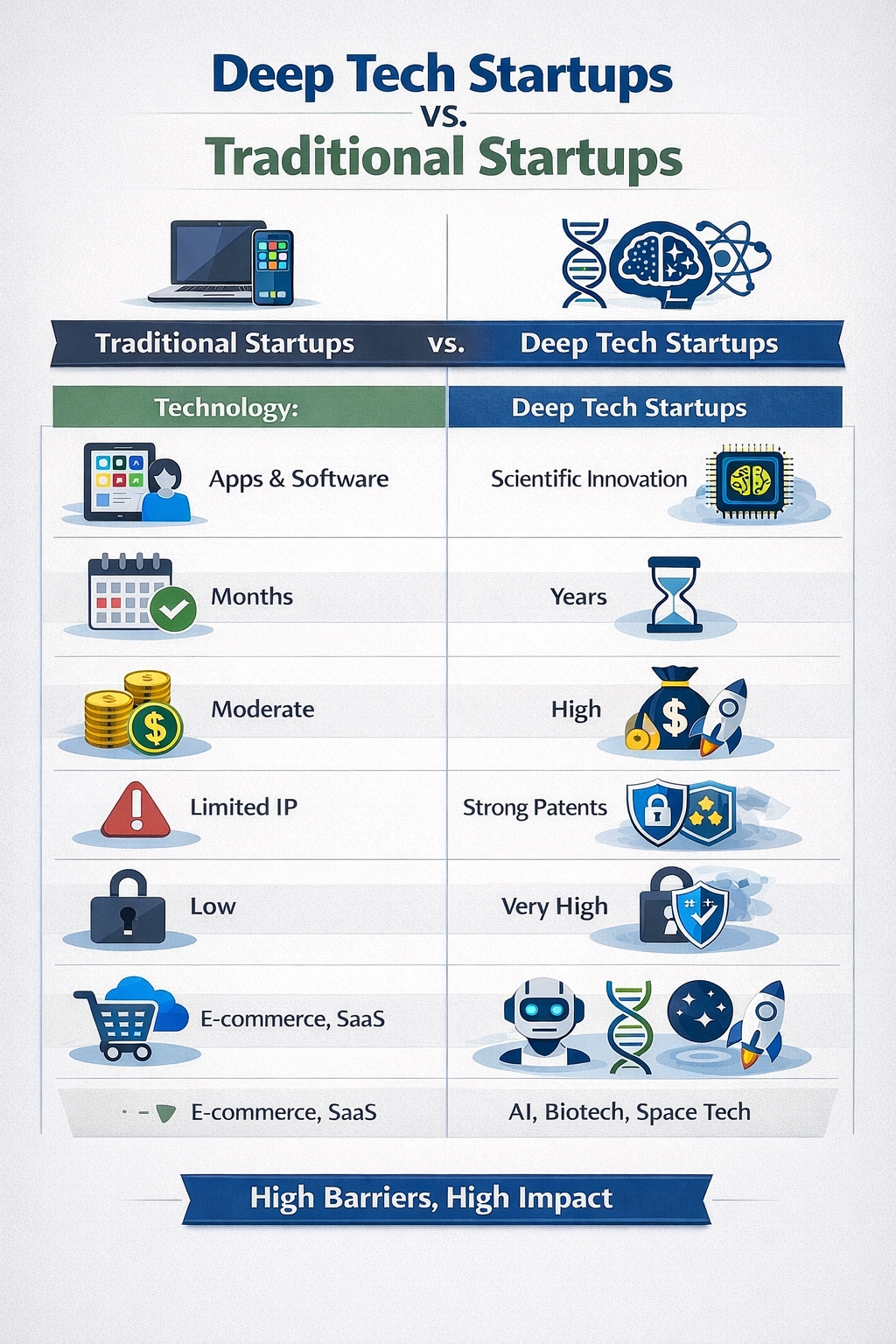
How Deep Tech Startups Differ from Traditional Startups
While both deep tech and traditional startups aim to innovate and scale, they differ in several important ways.
| Factor | Traditional Startup | Deep Tech Startup |
|---|---|---|
| Development timeline | Usually faster product launches | Often requires years of R&D |
| Technology complexity | Moderate | Extremely high scientific complexity |
| Funding requirements | Can start with smaller funding | Often requires large early investment |
| Competitive advantage | Speed, product experience, marketing | Scientific innovation and patents |
| Intellectual property | Sometimes limited | Usually protected by patents |
Traditional startups may focus on software platforms, marketplaces, or SaaS products, while deep tech startups focus on scientific and engineering breakthroughs.
Why Investors Are Interested in Deep Tech Startups
Over the last decade, there has been a significant rise in the number of venture capital firms and institutional investors investing in deep tech startups.
Several factors have contributed to the increased interest in deep tech startups.
1. Massive Market Opportunities
Deep tech startups tend to focus on huge markets and tackle fundamental issues.
For example:
- artificial intelligence
- biotechnology
- clean energy
These markets are enormous and can be addressed through deep technology innovation.
For instance, artificial intelligence has the capability to transform the world’s industries, biotechnology has the capability to change the world’s healthcare, and clean energy has the capability to change the world’s energy infrastructure.
Given the enormous size of these markets, deep tech startups can grow into multi-billion-dollar businesses.
Companies such as SpaceX, Moderna, and UiPath have successfully grown through deep technological innovation.
2. Strong Competitive Barriers
One of the most interesting aspects about deep tech startups is the level of protection offered by intellectual property rights.
Technologies protected by patents, proprietary algorithms, and complex engineering make it very difficult for competitors to replicate the innovation.
What this means for investors is that companies with technological leadership positions will be able to maintain competitive advantages over time.
3. Government Support and Research Funding
Governments all over the world are actively supporting the development and growth of deep tech innovations through research and funding programs.
Examples of this are:
- government research funding
- innovation funding
- public-private partnerships
- university commercialization programs
The DARPA research initiatives in the US and the Horizon Europe innovation program in the European Union are examples of research and innovation programs that provide substantial funding for breakthrough technologies.
This provides comfort for investors and allows capital to be invested in deep tech startups.
4. Long-Term Value Creation
Unlike many other consumer-focused startups, which are often focused on rapid growth and exits, deep tech startups are building technologies that will shape the future industries in which they are developed.
Breakthrough innovations in the following areas:
- advanced materials
- quantum computing
- biotechnology
- artificial intelligence
have the potential to generate enormous value in the future.
These investors will be able to reap the benefits in the future.
5. Solving Global Challenges
The world is facing many problems and challenges that require advanced technological solutions rather than simple software products.
These are the kinds of problems and challenges that deep tech startups are working hard to solve:
- climate change
- global healthcare challenges
- food security
- energy sustainability
- space exploration
Given this context, the need for deep tech innovation has become very important for both governments and investors.
Challenges Faced by Deep Tech Startups
Despite the opportunities in the deep tech sector, there are several challenges faced by deep tech startups.
Long Development Timelines
Breakthroughs in science may take many years before products are ready for commercial use.
High Capital Requirements
Developing deep technologies often requires specialized research facilities, research personnel, and costly equipment, which can be capital-intensive.
Hardware and Manufacturing Complexity
Deep tech startups often require innovation in hardware development and manufacturing processes, especially in industries such as robotics, aerospace, and materials science.
Regulatory Barriers
Sectors such as biotech, healthcare, energy, and aerospace often require government regulations and compliance, which can be a barrier to developing products.
The Future of Deep Tech Startups
The deep tech ecosystem is growing exponentially as academia, research institutions, and venture capital firms come together to commercialize scientific research and innovation.
Some global trends driving innovation in deep tech startups include:
- university commercialization research
- innovations in artificial intelligence and automation
- increased investment in climate change innovation
- increased government support for innovation
- expansion of venture capital funding for frontier innovation
In conclusion, these trends will continue in the coming years, and experts believe that the next global technology leaders will come from this space in the coming years.
Conclusion
Deep tech startups represent one of the most exciting areas in modern innovation history. By harnessing scientific research, innovation in engineering, and entrepreneurial zeal, these startups are developing technologies that can change industries in a revolutionary way.
Deep tech startups require more investment and a longer gestation period for innovation. However, these startups offer something incredibly valuable to investors: a chance to create revolutionary technologies with global impact.
As global problems become more complex and technology advances exponentially, deep tech startups will be one of the most critical innovation drivers in the coming decades.