

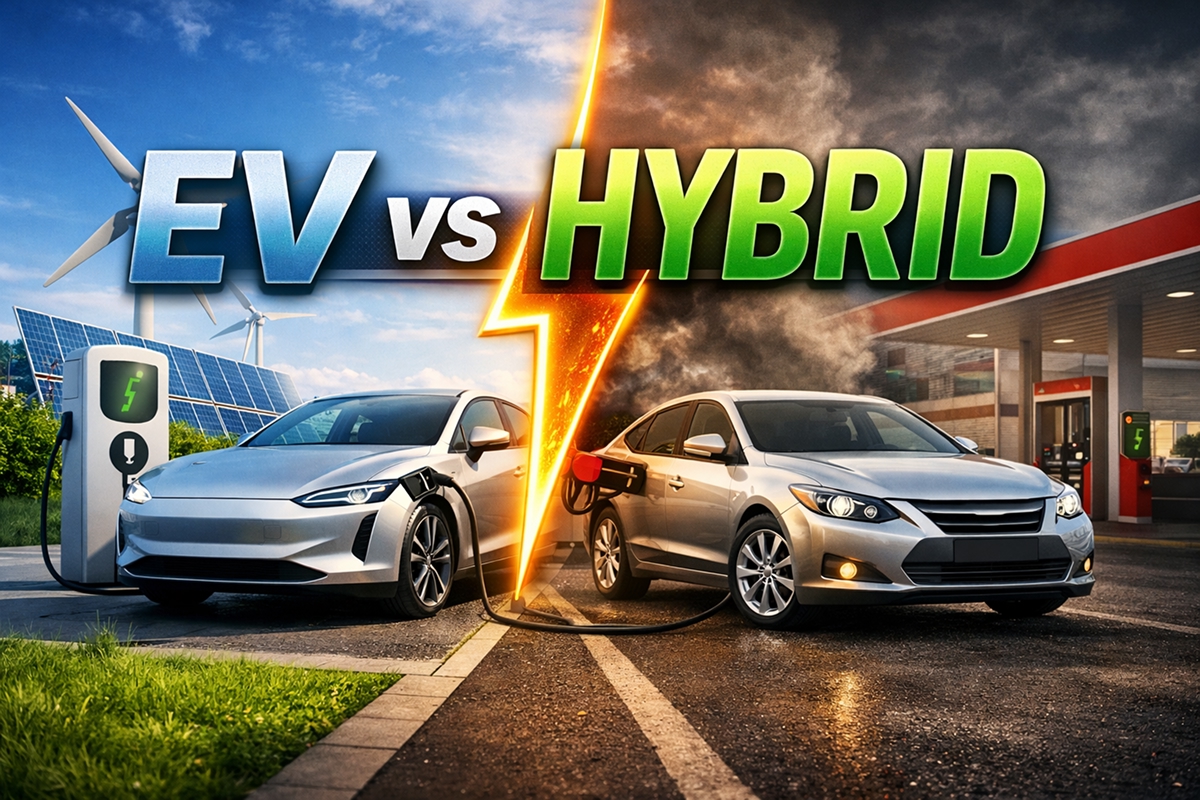
The world of the automotive industry is in the midst of one of the biggest revolutions ever seen in the history of the industry. As the world is moving towards cleaner technologies, the popularity of electric vehicles and hybrid cars is growing as alternatives to conventional gasoline-driven cars.
The world’s citizens are faced with an important decision: whether to buy an electric vehicle or a hybrid car.
Both of these technologies promise to reduce the usage of fuel and the emission of pollutants into the environment, but both do it in different ways, providing different advantages to the user. In the following article, the working of both electric vehicles and hybrid cars will be discussed, along with the advantages and disadvantages of both technologies, to determine which one of them is better for the user’s needs.
EV vs Hybrid: Comparison
| Feature | Electric Vehicle (EV) | Hybrid Vehicle |
|---|---|---|
| Power Source | Fully powered by electricity using battery and electric motor | Combination of gasoline engine and electric motor |
| Fuel Requirement | Electricity only | Gasoline + electricity |
| Emissions | Zero tailpipe emissions | Lower emissions than gasoline cars but not zero |
| Charging | Requires charging through home charger or public charging stations | Usually does not require charging (except plug-in hybrids) |
| Driving Range | Depends entirely on battery capacity | Longer range due to gasoline engine backup |
| Fuel Efficiency | No gasoline consumption | Uses less gasoline than conventional vehicles |
| Maintenance | Lower maintenance due to fewer moving parts | More complex system with engine and motor |
| Refueling Time | Charging can take longer depending on charger type | Refueling takes only a few minutes |
| Running Cost | Generally lower due to cheaper electricity | Lower than gasoline cars but higher than EVs |
| Environmental Impact | More environmentally friendly during operation | Better than traditional cars but still uses fossil fuel |
What Is an Electric Vehicle (EV)?
An Electric Vehicle (EV) is a vehicle that is powered solely by electricity, using one or more electric motors in place of a conventional internal combustion engine.
The vehicle runs on electricity stored in large batteries that power the motor of the vehicle.
Also Read: Biggest Tech Announcements of 2026 That Are Shaping Our Future
Key Characteristics of EVs
- Powered solely by electricity
- No gasoline or diesel engine required
- Rechargeable battery packs
- Zero tailpipe emissions
- Quiet operation
Some of the most prominent manufacturers of EVs include Tesla, BYD, Volkswagen, Hyundai, BMW, and many others.
Advantages of EVs
1. Zero Emissions
EVs produce zero tailpipe emissions, thus helping improve air quality.
2. Lower Running Costs
The cost of running an EV is often lower because electricity is usually cheaper than the gasoline required to run conventional vehicles.
3. Quiet and Smooth Driving
Electric motors have the benefit of providing instant torque, resulting in smoother and quieter driving.
4. Government Incentives
Different governments offer tax advantages, subsidies, and incentives for the purchase of EVs.
Disadvantages of EVs
1. Charging Infrastructure
Though the charging infrastructure for EVs is increasing rapidly, it has still not reached the level of gas stations.
2. Charging Time
Even though fast chargers can charge an EV quickly, it still takes more time to charge an EV than to fill up a gas-powered vehicle.
3. Range Anxiety
What if the electric vehicle runs out of power and there is no charging station nearby?
Also Read: What is Generative AI?
What Is a Hybrid Car?
A Hybrid Vehicle is a vehicle that has a traditional internal combustion engine, an electric motor, and a battery. A Hybrid Vehicle has the flexibility to operate on its internal combustion engine, its electric motor, or on a combination of both, depending on the driving circumstances.
Hybrid technology helps to increase fuel efficiency and reduce pollution compared to traditional vehicles.
There are some famous Hybrid Vehicle models from companies like Toyota, Honda, and Ford.
Types of Hybrid Vehicles
There are three kinds of Hybrid Vehicles:
1. Mild Hybrid Vehicle
- It has a small electric motor that assists the engine.
- It cannot operate on electric power alone.
2. Full Hybrid Vehicle
- It has the flexibility to operate on electric power alone, gasoline alone, or on a combination of electric and gasoline power.
- It has the flexibility to automatically switch between electric, gasoline, and a combination of electric and gasoline power.
3. Plug-in Hybrid Vehicle (PHEV)
- It has a larger battery.
- It has the flexibility to operate on electric power alone for short distances.
Advantages of Hybrid Cars
1. Better Fuel Efficiency
Hybrid cars consume less fuel compared to traditional gasoline-powered vehicles.
2. No Charging Anxiety
Hybrid cars do not depend entirely on charging infrastructure because they can still run on gasoline when needed.
3. Lower Emissions
Hybrid cars have lower emissions than conventional cars, though not zero emissions.
4. Easier Transition
The transition from conventional cars to hybrid cars is easier for people who are not yet ready to use electric cars.
Disadvantages of Hybrid Cars
1. Still Uses Fossil Fuel
As mentioned above, hybrid cars use gasoline as fuel. Therefore, they are not zero-emission cars.
2. More Complex Technology
The technology of hybrid cars is more complex than that of conventional cars. Hybrid cars have both an engine and an electric motor.
3. Limited Electric Range
Hybrid cars can only travel short distances using electric motors.
EV vs Hybrid: Key Differences
As mentioned above, electric cars and hybrid cars have different technologies. Although the objective of using both cars is the same, their differences are significant.
Here are the key differences that one should consider when choosing the best car.
1. Environmental Impact
As mentioned above, electric cars have zero tailpipe emissions. Therefore, they are environmentally friendly. Hybrid cars have emissions because they use gasoline as fuel.
2. Driving Range
The range of hybrid cars is longer than that of electric cars because they can travel long distances using gasoline.
3. Charging vs Refueling
Unlike electric cars, hybrid cars can be refueled at any gas station.
4. Maintenance
EVs also require less maintenance as they have fewer parts that can wear out. However, hybrid vehicles still require engine maintenance.
5. Initial Cost
The initial cost of an EV is usually higher compared to a hybrid vehicle. However, the cost of batteries is reducing dramatically.
Which One Should You Choose?
The choice between an EV and a hybrid car is determined by several factors. You can consider an EV or a hybrid car depending on your driving habits and budget.
Electric vehicle if:
- You have access to a reliable charging point
- You are concerned about reducing pollution
- You are looking for a cheaper alternative in the long run
Hybrid car if:
- You do not have access to a reliable charging point
- You drive long distances
- You are looking for a solution that can increase your car’s mileage
The Future of Mobility
The world is rapidly adopting clean transport technology. Several governments have announced their plans to stop using gasoline vehicles in the coming two decades. At the same time, automobile manufacturers are investing billions of dollars in electric vehicles.
Automobile manufacturers, including Tesla, BYD, and Volkswagen, are rapidly expanding their electric vehicles portfolio. Meanwhile, traditional automobile manufacturers are also working hard to make hybrid vehicles better.
In the coming years, several advancements in technology are expected to make electric vehicles a viable option for millions of people across the world.